
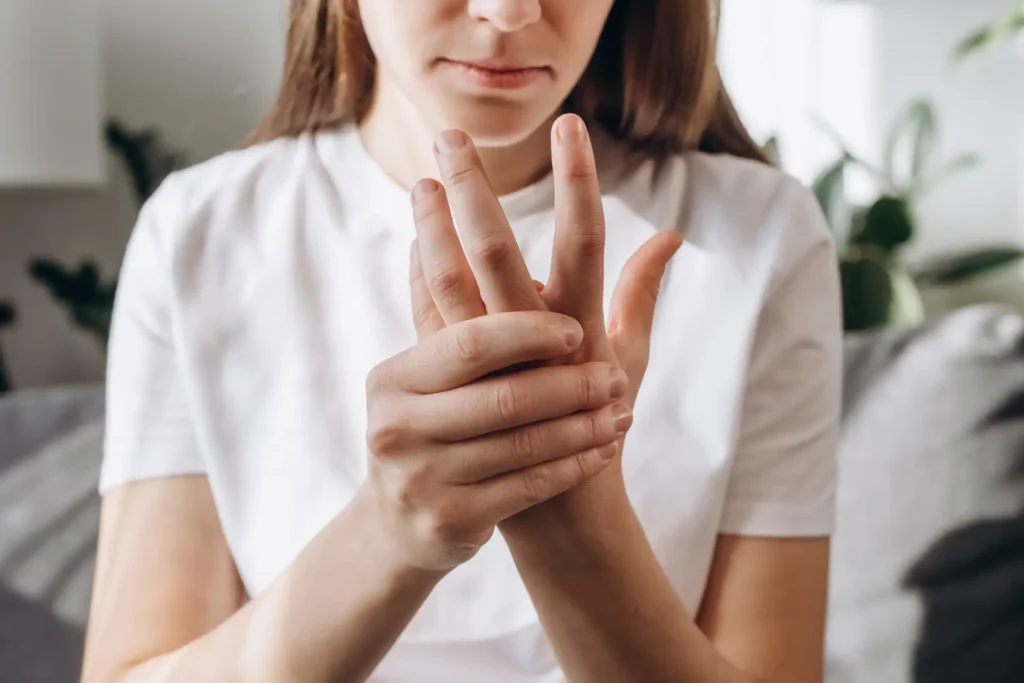
We use our hands for almost every single task throughout our day. From typing out emails and scrolling on our phones to turning a door handle, lifting a heavy skillet, or gripping a steering wheel, our hands and wrists are in constant motion. Because we rely on them so heavily, even a minor ache or a strange tingle in your fingers can quickly disrupt your entire life.
When hand or wrist pain begins to flare up, most people immediately jump to one conclusion: “I must have Carpal Tunnel Syndrome.” While Carpal Tunnel is highly common, it is far from the only cause of hand discomfort. Your wrist and hand are made up of an intricate network of 27 bones, dozens of ligaments, and an array of long tendons powered by muscles in your forearm.
If you are dealing with a persistent ache, a clicking finger, or a weak grip, understanding the true source of your pain is the first step toward recovery. Let’s look at three common conditions that go beyond carpal tunnel, how to spot them, and how specialized hand therapy can help you heal.
Three Common Causes of Hand Pain That Aren’t Carpal Tunnel
If your hand or wrist is throbbing, aching, or locking up, the issue might be driven by one of these highly treatable structural conditions:
1. De Quervain’s Tenosynovitis (The “Texting Thumb”)
This condition causes a sharp, burning pain directly at the base of your thumb and along the side of your wrist. It happens when the two main tendons that control your thumb become highly inflamed and swollen.
Think of these tendons like a rope passing through a narrow metal eyelet. If the rope swells from repetitive texting, lifting a new baby, or gripping tools, it rubs roughly against the eyelet every time you move your thumb. This makes lifting a coffee mug, wringing out a washcloth, or tucking in a shirt incredibly painful.
2. Trigger Finger (Stenosing Tenosynovitis)
Have you ever bent your finger or thumb completely closed, only to find that it catches, clicks, or physically locks into a bent position when you try to straighten it? This is Trigger Finger.
Your finger tendons run through a series of protective loops called pulleys, behaving exactly like a string on a fishing rod. If a tendon becomes inflamed, a tiny, tender nodule (a bump of swelling) can form on the tendon. When you bend your finger, that bump slides through the pulley loop, but when you try to straighten your hand, the bump gets physically trapped on the other side. This causes a painful pop or leaves your finger temporarily stuck in your palm.
3. Repetitive Strain Injuries (RSI) and Tendonitis
If you spend eight hours a day typing on a keyboard, using a mouse, or performing assembly-line work, you can develop localized tendonitis in your wrist. This is a repetitive strain injury where the tiny micro-tears that happen during daily work aren’t given enough rest to heal. It results in a dull, constant ache across the back of your hand or wrist that grows progressively worse by the end of your work week.
How Specialized Hand Therapy Can Help You Heal
Because the hand and wrist are so delicate, treating them requires a specialized, highly precise touch. Working with a dedicated clinician who understands upper extremity mechanics is the safest way to find lasting relief:
Custom Splinting and Off-Unloading
During the early, highly painful stages of conditions like De Quervain’s or Trigger Finger, aggressive stretching will only make the swelling worse. Your therapist can provide or craft a lightweight, custom-fitted splint that keeps your irritated joint in a safe, neutral position. By resting the specific tendon for a short time, the internal “traffic jam” clears out, lowering your pain instantly.
Tendon Gliding Exercises
Nerves and tendons need to slide smoothly against each other. If you have been keeping your hand still because it hurts, the tissues can get sticky and bound together. We use a specialized protocol called tendon gliding exercises. These are precise, sequence-based finger movements (making a hook fist, a flat fist, and a full fist) that smoothly stretch individual sections of your tendons, restoring your fluid movement without flaring up the joint.
Ergonomic and Grip Modifications
To stop the pain from returning, we evaluate how you use your hands in the real world. Your therapist will look at your typing posture, how you hold your phone, or how you grip tools at work. By introducing small, simple changes—like using a vertical mouse, changing your grip diameter, or learning joint-protection techniques—we can take the mechanical stress off your hands so you can work comfortably.
Conclusion
Hand and wrist pain can make everyday tasks feel frustrating, but your hands are remarkably adaptable. You don’t have to just live with a clicking finger or an aching wrist, and you don’t have to automatically assume you need a surgical release. By partnering with a specialized therapy team, you can calm the inflammation, protect your joints, and restore the precise, pain-free movement you need for daily life.
PT Pros has fifteen clinic locations throughout Kentucky. Find a clinic location near you: Barbourville, KY • Columbia, KY • Corbin, KY • Danville, KY • Elizabethtown, KY • Eminence, KY • Greensburg, KY • Harlan, KY • Hazard, KY • Leitchfield, KY • Lexington, KY • London, KY • Louisville, KY • Somerset, KY • Williamsburg, KY