
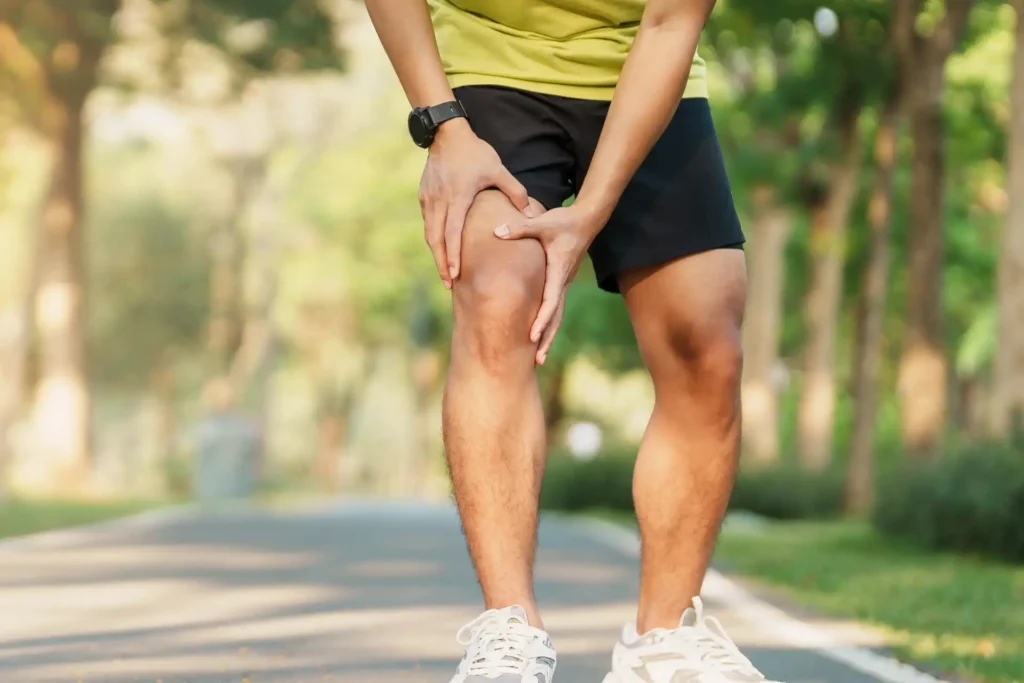
Knee pain is one of the most common reasons people step away from the activities they love. Whether it’s a dull, nagging ache that flares up during a morning jog, a sharp twinge when walking down a flight of stairs, or a stiff, heavy feeling when getting out of bed, chronic knee pain can make your world feel a lot smaller.
When knee discomfort sticks around for weeks or months, many individuals immediately jump to the worst-case scenario: “My cartilage must be completely gone, and I’m heading straight for a joint replacement.” However, chronic knee pain can be caused by several completely different structural issues. Two of the most common culprits are Patellofemoral Pain Syndrome (commonly known as Runner’s Knee) and Knee Osteoarthritis (OA).
While both conditions cause an ache around the knee joint, they behave entirely differently and require unique treatment strategies. Let’s break down the differences between these two conditions, how to tell which one you might have, and how physical therapy can help you find lasting relief.
Runner’s Knee: The Tracking Issue
Despite its popular nickname, you do not have to be an elite marathon runner to develop Runner’s Knee. This condition can affect anyone—from desk workers and weekend hikers to teenagers and active older adults.
Runner’s Knee happens when your kneecap (the patella) does not slide smoothly within the bony groove at the end of your thigh bone. Think of your kneecap like a train and the groove like a train track. If the train is pulled even a tiny bit off-center, it begins to rub roughly against the side of the track. Over time, this repetitive rubbing irritates the sensitive soft tissues and cartilage underneath the kneecap, resulting in a dull, aching pain right behind or around the front of your knee.
Key Signs of Runner’s Knee:
-
The pain is located primarily at the front of the knee or directly under the kneecap.
-
It hurts worst when sitting for long periods with your knees bent (often called the “theater sign”).
-
Squatting, running, or walking down stairs triggers a sharp or throbbing ache.
-
Your knee joint rarely feels stiff in the morning, and it doesn’t typically swell up like a balloon.
Knee Osteoarthritis: The Wear-and-Repair Process
On the other side of the spectrum is Knee Osteoarthritis. Osteoarthritis is a degenerative condition that typically develops gradually over time, making it much more common in individuals over the age of 45.
Inside a healthy knee, the ends of your bones are capped with a slick, rubbery tissue called articular cartilage, which acts as a built-in shock absorber. Over years of walking, running, and living, this cartilage can naturally experience wear and tear. As the cartilage thins, the joint space shrinks, and the bones can begin to rub closer together. The body tries to repair this by creating tiny bumps of extra bone (bone spurs), which can lead to friction, inflammation, and structural stiffness.
Key Signs of Knee Osteoarthritis:
-
The pain is often felt deep inside the joint, frequently concentrated on the inner (medial) side of the knee.
-
You experience significant morning stiffness that takes 20 to 30 minutes to “warm up” and loosen.
-
The joint may look slightly enlarged, feel warm, or occasionally swell after heavy activity.
-
You might hear or feel a grinding, crunching sensation (crepitus) deep inside the knee when bending it.
How to Tell the Difference: A Quick Comparison
To help give you a clear picture of how these two conditions differ, look at this quick breakdown:
| Feature | Runner’s Knee (Patellofemoral Pain) | Knee Osteoarthritis (OA) |
| Primary Age Group | Teens, 20s, 30s, and active adults | Typically 45 years of age and older |
| Pain Location | Front of the knee, around/under kneecap | Deep inside the joint, often on the inner side |
| Morning Stiffness | Rare; knee usually feels fine right out of bed | Common; joint feels very stiff for the first 30 mins |
| Main Trigger | Prolonged sitting, running, going down stairs | Prolonged standing, heavy walking, going up stairs |
How Physical Therapy Corrects Both Conditions
Whether your chronic knee pain is driven by a tracking issue or joint degeneration, the ultimate solution is rarely found in a bottle of pain medication or a restrictive brace. Your knee joint relies entirely on the muscles above and below it to absorb structural shock. Physical therapy treats the root cause of both conditions by balancing the kinetic chain:
For Runner’s Knee: Restoring the Track
If your kneecap is pulling off-center, we don’t just treat the knee—we look at your hips and feet. Frequently, Runner’s Knee is caused by weakness in the glute muscles, which allows the thigh bone to twist inward, or flat feet that collapse during a stride. Your physical therapist will use targeted exercises to strengthen your glutes, balance your quadriceps, and retrain your running or walking stride so your “train stays perfectly on the tracks.”
For Osteoarthritis: Building a Natural Shock Absorber
You cannot mathematically grow new cartilage, but you can build a muscular suspension system that unloads the arthritic joint. By safely strengthening your quadriceps, hamstrings, and calf muscles through low-impact, joint-friendly exercises, we can drastically reduce the amount of physical weight pressing down on your bone cartilage. This lowers friction, eliminates morning stiffness, and can successfully delay or completely prevent the need for a total joint replacement.
Conclusion
Chronic knee pain can be incredibly frustrating, but you do not have to accept it as a permanent limitation. Whether you are dealing with a mechanical tracking issue like Runner’s Knee or natural joint wear-and-tear like Osteoarthritis, your body is fully capable of adapting and moving without pain. By working with a physical therapist, you can build a stronger foundation, protect your joints, and get back to your active lifestyle with confidence.
PT Pros has fifteen clinic locations throughout Kentucky. Find a clinic location near you: Barbourville, KY • Columbia, KY • Corbin, KY • Danville, KY • Elizabethtown, KY • Eminence, KY • Greensburg, KY • Harlan, KY • Hazard, KY • Leitchfield, KY • Lexington, KY • London, KY • Louisville, KY • Somerset, KY • Williamsburg, KY